A hearing aid is a small electronic device that makes sound louder and clearer, so people with hearing loss can follow conversations and take part in daily life more easily. Untreated hearing loss affects relationships and well-being, and can leave people feeling lonely, frustrated or low.
Hearing aids are not suitable for everyone. Your audiologist will advise whether one is right for you, based on a hearing test.
Understanding hearing loss
Hearing loss varies in severity and is usually one of two types:
- Sensorineural: caused by damage to the inner ear or the hearing nerve.
- Conductive: caused by problems in the middle ear.
It can result from loud noise, family history, ageing or other medical conditions, and may be temporary or permanent. For most types of hearing loss, a hearing aid is one of the most effective solutions.
How hearing aids work
Every hearing aid has the same five key parts:
- Microphone: picks up sound around you and turns it into digital signals.
- Microchip: a tiny computer that your audiologist programs to suit your hearing.
- Amplifier: strengthens the signals.
- Receiver (speaker): turns the signals back into sound and delivers it into the ear.
- Battery: powers the device. It may be a small replaceable cell or built-in and rechargeable.
Digital hearing aids
In a digital hearing aid, sound is converted into numbers and processed mathematically. This allows the aid to separate speech from background noise, and to split sound into frequency bands so that each band is amplified according to your hearing loss. Soft sounds become audible while loud sounds stay comfortable, giving a more natural sound.
Digital aids are programmable, so your audiologist can fine-tune the settings and features for you. Common features include:
- Noise reduction and wind noise reduction
- Feedback (whistling) management
- Directional microphones for focused listening
- Bluetooth connection to phones and other devices, for calls and music
- Data logging, which records how the aid is used
- User programmes for different settings, such as a restaurant or outdoors, changed with a button or a phone app
- Remote or online fine-tuning
- Rechargeable batteries and water and dust resistance
Types of hearing aids
The technology you need is decided after a thorough pre-fitting check-up and a look at your lifestyle. The style is often your choice, based on comfort and appearance.
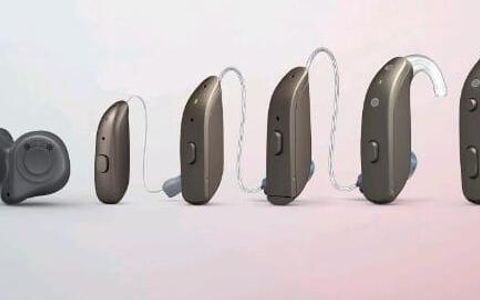
- Behind-the-ear (BTE): sits behind the ear, connected by a tube to an earpiece. Suitable for mild to severe hearing loss.
- In-the-ear (ITE): custom-made, with the electronics inside the earpiece. Suitable for mild to severe hearing loss.
- In-the-canal (ITC): smaller and less visible, sitting deeper in the ear canal. Suitable for mild to moderate hearing loss.
- Completely-in-the-canal (CIC): very small and placed deep in the canal. Suitable for mild to moderate hearing loss.
- Invisible-in-canal (IIC): the most discreet style.
- Receiver-in-canal (RIC) or open fit: a microphone behind the ear and a receiver in the canal. A flexible option for moderate to profound hearing loss.
For some types of conductive hearing loss, a bone-conduction device, which sends sound through the skull to the inner ear, may be more suitable. See bone-conduction implants.
We work with several well-known hearing aid brands, including Phonak, Signia, Starkey, ReSound and Widex.
Choosing the right hearing aid
Your audiologist will help you weigh up:
- How much amplification you need
- Noise reduction and speech features
- How discreet you want the aid to be
- Connectivity, such as Bluetooth
- Battery life
- Budget and warranty
Prices vary with the style, features and brand, from basic models to premium ones. Your audiologist will help you find an option that fits your needs and budget.
Fitting and follow-up
At a hearing aid evaluation, we review your hearing test results, let you try different styles, and adjust the settings in real time. You can try devices from up to three brands during your visit. A fitting takes about 60 to 90 minutes, which gives time to discuss your needs, fit the device, run an aided audiogram and fine-tune the programming.
If a custom aid is recommended, the audiologist takes an impression of your ear so it fits well. We show you how to use and care for the aid, and you have a follow-up appointment about a month after fitting. We also offer a two-week trial: if you are not satisfied, we adjust the settings or look at other devices.
Care, adjustments and repairs
- Clean your aids daily with a soft brush and change wax guards weekly.
- Book a professional check every six months.
- With proper care, digital hearing aids usually last three to five years.
If your hearing changes, come back at any time. We will re-test your hearing and reprogram your aids. If you have a problem with an existing hearing aid, such as poor sound quality or loudness, our audiologists can assess it and adjust the programming. If there is an internal fault, we send the aid to the manufacturer's lab for testing and repair.